
The March 31 deadline for filing Compliance Audit Returns (CAR) with the Nigeria Data Protection Commission is more than an administrative requirement, it’s a diagnostic test that separates organisations with mature data protection governance from those still scrambling to build foundational capabilities.
There are five types of organisations affected by this deadline, with their behaviours reflecting varied levels of governance maturity. The nascent Level One (Aware), features organisations demonstrating crisis-driven compliance characterised by missing deadlines or submitting incomplete documentation.
These organisations lack systematic record-keeping, maintain outdated or copied privacy policies, and designate Data Protection Officers without providing adequate authority, budget, or resources. Their compliance efforts emerge only when enforcement becomes imminent, leaving them exposed to significant penalties and regulatory scrutiny.
Level Two (Reactive) organisations achieve deadline-focused compliance through intensive preparation efforts concentrated in the final six to eight week sprint before the March deadline. While they produce the required documentation and meet submission deadlines, audits typically expose disconnects between documented policies and operational practices. Their Data Protection Officers often lack sufficient expertise or resources to drive meaningful change, and privacy policies reflect aspirational rather than actual data handling practices. These organisations manage checkbox compliance but struggle when auditors examine implementation depth.
At Level Three (Proactive), organisations demonstrate proactive compliance through systematic processes maintained throughout the year. They commence audit preparation in the fourth quarter of the previous year, empower Data Protection Officers with clear executive reporting lines, conduct regular training programs, and perform Data Protection Impact Assessments for high-risk processing activities. Their documentation reflects operational reality because compliance is integrated into business processes, rather than existing as an isolated function. For these organisations, the March deadline represents validation instead of crisis.
Level Four (Managed) organisations maintain continuous audit readiness through integrated compliance monitoring systems. Automated tracking mechanisms cover data processing activities and compliance metrics. Periodic internal audits identify and address issues before external auditors arrive. Privacy-by-design principles are embedded in system development methodologies to drive repeatable and scalable processes. Cross-functional governance committees are established to provide executive oversight and ensure adequate resource allocation. These organisations could submit Compliance Audit Returns at any time due to their semi-autonomous governance infrastructure, instead of being activated on an ad hoc basis.
Level Five (Optimised) organisations represent governance optimisation where data protection functions as a competitive differentiator rather than a compliance burden. Organisations at this level innovate with privacy-enhancing technologies, contribute to the development of industry standards, and optimise their privacy practices and data governance frameworks based on emerging threats and regulatory developments. Their relationships with Data Protection Compliance Organisations (DPCOs) resemble strategic partnerships focused on identifying opportunities for improvement; not remediating deficiencies.
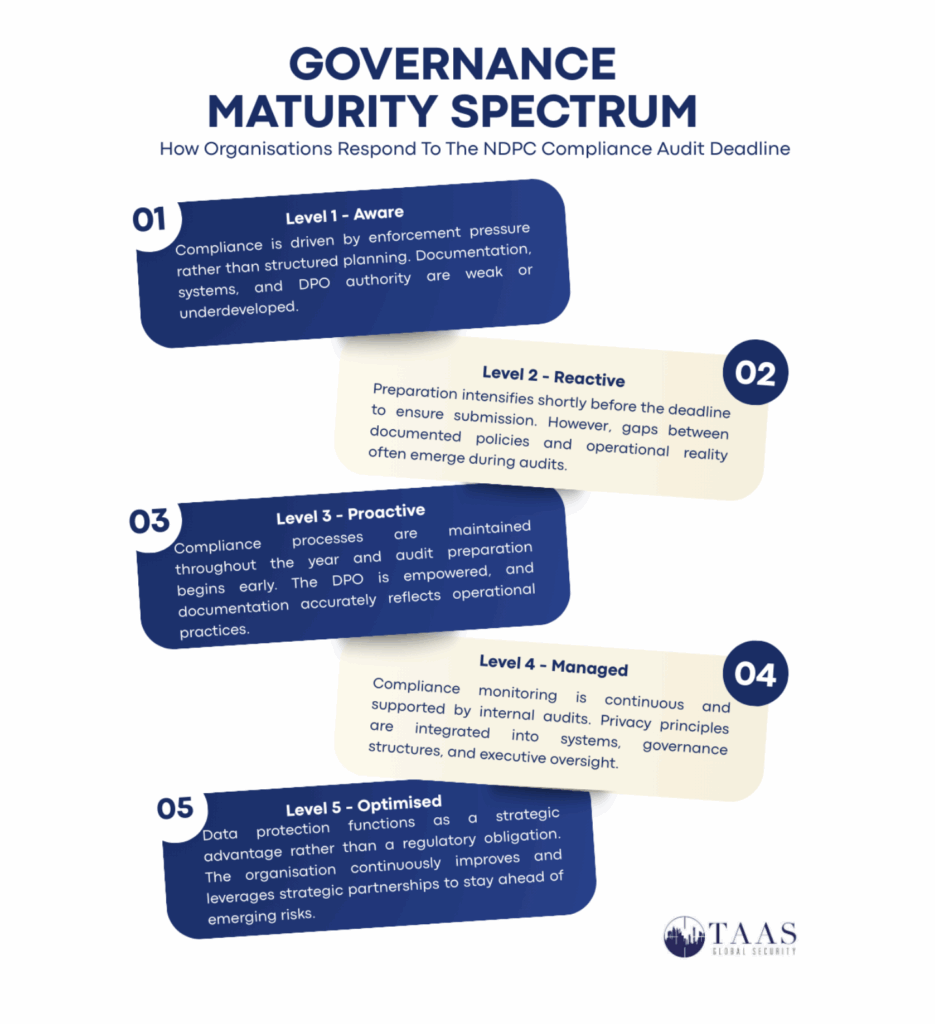
If your organisation falls into Level 1 or 2, here is some expert-level guidance on how to navigate through your compliance maturity journey.
1. Assessment: This phase requires verification of Data Protection Officer’s competency (upskilling where needed), comprehensive mapping of all data processing activities, identification of lawful bases for each processing operation, evaluation of existing privacy policies and notices, assessment of technical security measures, and identification of critical compliance gaps. Most importantly, organisations must engage a licensed Data Protection Compliance Organisation – like T.A.A.S Cyber Solutions Ltd – early to allow adequate time for assessment, remediation, and filing preparation.
2. Implementation: Implementation efforts should prioritise updating privacy policies for Nigeria Data Protection Act compliance, as well as to reflect the company’s data processing activities. Next, formalise the Data Protection Officer (DPO) appointment with clear mandates and reporting lines. The DPO shall oversee key processes like completing comprehensive data processing inventories, conducting Data Protection Impact Assessments for high-risk activities, executing data processing agreements with third parties and implementing fundamental security measures including access control, encryption, and monitoring capabilities. Organisations unable to achieve full compliance by March 31 can submit memoranda outlining time-bound remediation plans alongside their Compliance Audit Returns, demonstrating good faith efforts while acknowledging remaining gaps.
3. Submission: This phase requires the Data Protection Compliance Organisation’s final assessment, review of Compliance Audit Return accuracy by Management, executive sign-off, fee payment, and filing through the Commission’s portal. Organisations should target March 25 submission to provide buffer for technical issues rather than waiting until the final deadline. Upon the successful filing of your organisation’s CAR, you will receive a Trust Mark signalling credibility and value in the wider business ecosystem.
The Strategic Value of Governance Maturity
Organisations with mature data protection governance models increasingly recognise that audit readiness delivers strategic value-add well beyond regulatory compliance. Standardised processes reduce operational inefficiencies and minimise the risk of error, while clear accountability frameworks remove ambiguity around data protection responsibilities across the organisation.
As a licensed Data Protection Compliance Organisation (DPCO), T.A.A.S Cyber Solutions Ltd helps organisations achieve this maturity by translating regulatory requirements into practical, embedded controls while fostering a privacy culture that shifts organisations from reactive incident response to proactive risk prevention.
To attain successful governance maturity, there are four key elements to consistently assess:
1. Executive sponsorship: This requires a dedicated budget, active leadership involvement for top-down buy in, and clearly assigned executive accountability for data protection oversight.
2. Cross-functional collaboration: Data protection affects information security, legal and compliance, human resources, marketing, sales and operational teams. Effective governance therefore requires deliberate collaboration across these functions.
3. Technology investments to support operational efficiency: Compliance solutions must integrate with existing systems and workflows, avoiding standalone tools that create duplication or operational friction.
4. External expertise: Engaging a licensed Data Protection Compliance Organisation such as T.A.A.S Cyber Solutions Ltd helps organisations build capability faster and avoid tackling complex regulatory issues alone.
This need for maturity is reinforced by the evolving posture of the Nigeria Data Protection Commission (NDPC), which has shifted from primarily advisory and guidance to active enforcement. Sector-wide investigations, compliance orders, and administrative penalties now signal clear regulatory intent. While financial sanctions are significant, reputational damage and potential market exclusion often carry greater long-term consequences, particularly for organisations whose business models depend on trust and credibility. Organisations processing personal data in Nigeria must therefore assess their current maturity levels with honesty, engage Data Protection Compliance Organisations without delay where gaps exist, prioritise remediation efforts to address genuine risk exposure, and comprehensively document compliance activities. Beyond this, sustainable governance systems must be built to endure beyond a single audit cycle, with audit findings treated as diagnostic learning tools rather than compliance failures to be obscured.
Ultimately, the real test of governance maturity extends beyond meeting the 31 March filing deadline. It lies in an organisation’s ability to transform annual audit submissions from crisis-driven exercises into routine validations of established capability. Those that use the audit cycle as a catalyst for systematic improvement position themselves not only for regulatory compliance, but for sustainable competitive advantage in global markets increasingly sensitive to data protection credibility. The deadline merely reveals maturity levels that no amount of last-minute preparation can conceal. The question organisations must confront is whether their audit readiness reflects genuine governance capability, or simply a more sophisticated form of compliance theatre.